What is Cyber Security?

Cybersecurity is like having a set of high-tech tools and strategies that protect your computer, gadgets, and sensitive info from sneaky online threats, ranging from pesky viruses to sophisticated ransomware attacks. It’s basically your digital bodyguard, ensuring your online world stays safe and sound.
Technically, Cybersecurity involves employing technology, measures, and practices to prevent or minimize the impact of Cyberattacks. It strives to defend systems, applications, computing devices, sensitive data, and financial assets against a spectrum of threats, including both simple computer viruses and sophisticated ransomware attacks.
Research has it that global cybercrime caused approximately $6 trillion USD in damages in 2021. According to a recent survey by KPMG involving 500 CEOs, 18% identified cybersecurity risk as the primary threat to their organization’s growth by 2024, an increase from 10% the previous year.
Is Cyber Security a High income skill?

Cybersecurity offers lucrative opportunities with entry-level positions starting at $50,000. As you accumulate experience, you can swiftly progress to six-figure salaries. A formal degree is not a requirement; possessing IT knowledge and transferable organizational skills can be instrumental in securing high-paying cybersecurity roles.
Types of Cyber security
An effective cybersecurity plan shields every applicable IT infrastructure layer or domain from the risks of cyber threats and criminal activities.
Below are some types of Cyber security that exist:
- Network Security
Network Security keeps unauthorized users out, identifies and halts cyberattacks and breaches, all while ensuring that authorized users can securely access needed network resources promptly.
- Cloud Security
Cloud security involves safeguarding an organization’s assets within the cloud, encompassing applications, data, storage, development tools, virtual servers, and the cloud infrastructure itself. In a nutshell, it follows the shared responsibility model: the cloud provider secures the services and infrastructure they provide, while the duty is on the customer to protect their data, code, and other assets utilized or stored in the cloud. The specifics of this responsibility division may vary based on the specific cloud services in use.
- Endpoint security
Endpoint security is crucial for safeguarding servers, desktops, laptops, and mobile devices, as these are the main targets for cyberattacks (that’s why they’re called the endpoints). These devices serve as the entry or termination point for potential cyber threats.
Securing these endpoints is essential to protect against various types of cyberattacks. Endpoint security not only defends these devices and users from attacks but also shields the network from adversaries who exploit endpoints to launch their attacks.
- Firewall
Firewall offer defense against external cyber threats by safeguarding your computer or network from harmful or superfluous network activity. They also have the ability to block malicious software from infiltrating a computer or network through the internet.
Common Cyber Threats

- Malware
Malware for short means- malicious software. It encompasses various cyber threats such as viruses,worms,Trojans,spyware,and ransomware, constituting prevalent forms of cyberattacks. It infiltrates systems through untrusted links, emails,or unwanted software downloads,executing on the target to collect sensitive data,manipulate network access,and potentially destroy or shut down the system.
Diverse types of malware attacks include;
- Viruses injecting code into applications
- Worm exploiting vulnerabilities for system access
- Trojans disguising as innocent programs to gain control
- Cryptojacking utilizing computing resources for cryptocurrency
- Spyware accessing user data to monitor their activities.
- Adware tracking browsing activity for targeted ads
- Fileless malware modifying native files for stealthy attacks and
- Rootkit provides remote administrative access to compromise computers.
Also we have:
- Phishing Attacks
Phishing Attacks involve deceptive emails, texts or voice messages designed to deceive users into downloading malware,disclosing sensitive information,or making erroneous financial transactions.
While many users are familiar with widespread phishing scams that impersonate trusted brands for password resets or credit card details, more advanced forms like spear phishing and business email compromise specifically target individuals or groups to extract valuable data or substantial sums of money.
Phishing falls under the broader category of social engineering,which means to employ psychological manipulations to influence.
- Ransomware
Basically, ransomware encrypts data for a ransom. Ransomware attacks pose significant financial and operational threats to organizations, necessitating robust prevention measures within cybersecurity frameworks. While complete immunity is unattainable, various strategies can enhance protection.
Essentially, a ransomware attack involves unauthorized access to a network, where attackers encrypt data or systems, demanding a ransom for potential decryption. Despite promises, paying the ransom doesn’t assure the restoration of access. Implementing diverse prevention tactics is crucial for mitigating the impact of these disruptive attacks.
Cyber Security Best Practices You Should Know
- Install anti-malware software
This is like putting a shield on your computer. It keeps out sneaky bad stuff from emails or websites, making sure your digital space stays safe. It’s a must-do in the world of cyber safety!
- Employ Safe Password Practices
This means having strong and unique passwords. It’s like locking your digital front door with a code only you know. That way, it’s way tougher for cyber baddies to sneak in and cause trouble. Be the boss of your passwords.
- Use Firewall
Using a firewall is crucial for your computer’s security. It acts as a barrier, monitoring and controlling incoming and outgoing network traffic. It helps prevent unauthorized access and protects your system from potential cyber threats. It’s like having a sturdy gate for your digital fortress.
- Use Multi-Factor Identification
This is a serious cybersecurity move. It adds an extra layer of protection by requiring more than just a password to access your accounts. This way, even if someone gets hold of your password, they still need another piece of info, like a code sent to your phone. It’s a powerful defense against unauthorized access. Double protection for the win!
Top 5 Reasons To Learn Cyber Security

- Cyber security is your responsibility
In a world immersed in tech, staying safe begins with understanding cyber security. Education and awareness are the keys.
- Outsmarting Cybercrime
Hackers are on the rise. That is why you should build up arsenals for defense. Empowering yourself to become smarter in digital design and protecting information will do a great job.
- Cyber Attacks hit close to home
Imagine losing your private photos or sensitive info. Cyber attacks hit hard_ be prepared.
- Tech Savvy in the digital world
With an average of 4 connected devices per person, navigating the digital world is essential.You should learn to use tech safely- it’s your daily companion!
- Secure your future
Learning cybersecurity ensures a secure future by equipping you with in-demand skills, as the increasing complexity of cyber threats creates a growing demand for professionals who can safeguard digital assets and sensitive information in various industries.
How to Get Started with Cyber Security
You can initiate your cybersecurity journey by mastering networking fundamentals, acquiring proficiency in key programming languages, obtaining relevant certifications, and actively engaging in ethical hacking exercises.
Most importantly, maintain a commitment to continuous learning to effectively navigate the ever-evolving landscape of cybersecurity.
What You Will Learn in Our Course
DON’T GO FURTHER FROM HERE IF YOUR DESIRE
IS TO BECOME A CYBER SECURITY EXPERT
If you read this to the end, I promise you this is the best opportunity
you’ll ever come across online this year 2024
YES! IF YOUR DESIRE IS TO BECOME A CYBER SECURITY EXPERT
I GUARANTEE YOU THAT YOUR FINANCIAL LIFE WILL NEVER REMAIN THE SAME
THE GOOD NEWS IS THAT YOU HAVE FINALLY MET THE COURSE THAT’LL FOREVER
TRANSFORM YOUR LIFE INTO BECOMING A PROFESSIONAL CYBER SECURITY EXPERThttps://www.youtube.com/embed/5x00ikjz7Ew?showinfo=0
What You Will Learn
Introduction to Cybersecurity
*Overview of cybersecurity concepts
*Importance of cybersecurity in today’s world
*Key cybersecurity principles and terminology
*Information Security Fundamentals
Confidentiality, integrity, and availability (CIA) triad
*Risk assessment and management
*Security policies and procedures
*Network Security
Network architecture and protocols
*Firewalls and intrusion detection/prevention systems (IDS/IPS)
*Virtual Private Networks (VPNs)
Operating System Security
Securing different operating systems (Windows, Linux, macOS)
*User access control and permissions
*Patch management and updates
*Cryptography
Encryption and decryption
Public key infrastructure (PKI)
*Cryptographic algorithms and protocols
*Cyber Threats and Attacks
Types of cyber threats (malware, phishing, DDoS, etc.)
*Social engineering attacks
*Incident response and handling
Web Security
Web application vulnerabilities (SQL injection, XSS, CSRF)
* Web security best practices
Secure coding principles
* Wireless Security
Wi-Fi security (WPA, WPA2, WPA3)
Bluetooth and IoT security
Mobile device security
Cloud Security
Cloud computing models (IaaS, PaaS, SaaS)
Cloud security challenges and solutions
Data protection in the cloud
Ethical Hacking and Penetration Testing
Introduction to ethical hacking
* Penetration testing methodologies
Vulnerability assessment and remediation
*Security Governance and Compliance
Security policies and standards
Regulatory compliance (e.g., GDPR, HIPAA)
Security auditing and assessment
Security Awareness and Training
Employee security awareness programs
Social engineering awareness
Phishing simulation exercises
Cybersecurity Career Paths and Certifications
Career options in cybersecurity
Industry-recognized certifications (CISSP, CEH, etc.)
Building a cybersecurity career
Emerging Trends in Cybersecurity
AI and machine learning in cybersecurity
Blockchain security
IoT security challenges
Capstone Project or Lab Work
COMMONLY ASKED QUESTIONS BY THE STUDENTS
Why do I need to learn Cyber security?
Ans:
✅To Change Your Financial Life
✅For Personal security online
✅Professional opportunities
✅Protecting Data Assets
✅Preventing Cyberattacks
✅National security
✅Futuristic highly demand field
✅Protection Against Emerging Cyber Threats
1. Please where is your location?
Ans: it’s not a physical class, it’s a well detailed video course and PDF’S with free mentorship.
2. Can I use my phone?
Answer: Yes you can use your phone to learn.
3. How will i get the course?
Answer: It will be sent to your email address and it will reflect on your goggle drive, so you can easily watch or download videos.
4. Am a newbie in tech?
Ans: Yes you can get the courses, the courses are from scratch.
5. Is there certificate after conclusion?
Answer: Yes, the knowledge you will acquire is your certificate.
It’s a self paced course we don’t issue certificate.
6. How long will the courses last?
Answer: it’s a self paced course, its depends on the course you’re learning and how dedicated you are to it.
7. What if I got stucked in the process of learning?
Answer: That’s why it’s advisable you save my contact, so you can easily get back to me.
8. Are these all your courses?
Answer: No, we have over 50 different courses.
9. Am afraid of been sc@mmed, hope I can trust you?
Answer: YES, We are Registered Under CORPORATE AFFAIRS COMMISSION (CAC)
BONUSES:
1) I’LL ADD YOU TO THREE ETHICAL HACKING CHANNELS TO LEARN FROM EXPERTS DAILY WORTH 100K
2) COMEPLETE FACEBOOK AND INSTAGRAM ADS COURSE WORTH 10K
3) AI ART AND ANIMATION COURSE WORTH 5K
4) 200+ PREMIUM APPS WORTH 200K
5) COMPLETE PAYPAL CREATION COURSE WORTH 25K
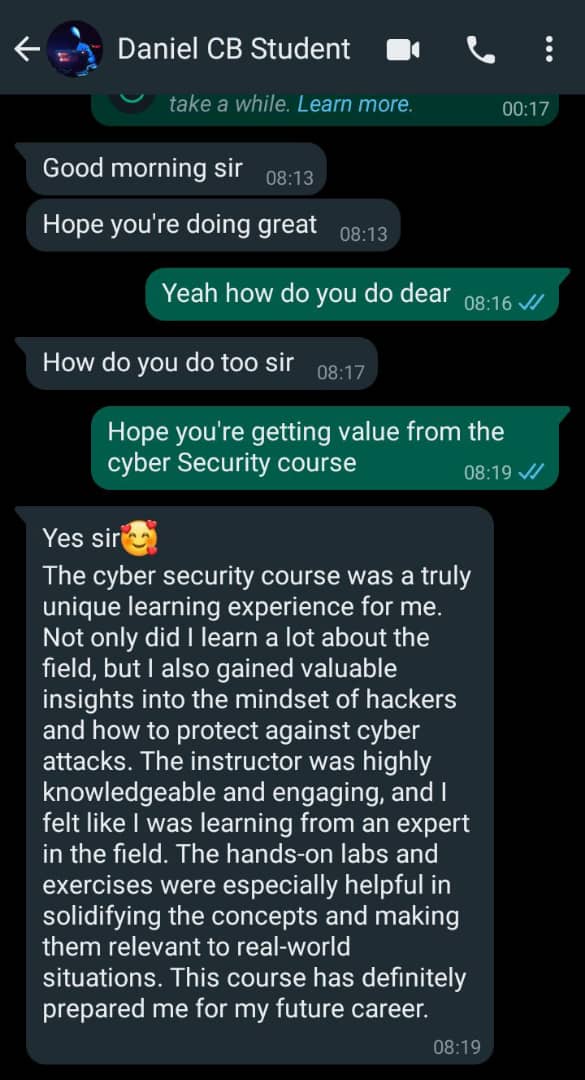
TESTIMONIALS
See what some of our students say about our cyber security course



WE ARE REGISTERED UNDER CORPORATE AFFAIRS COMMISSION (CAC)
Below is our certificate

Our company VATHOS TECHNOLOGIES is registered under CAC
Kindly visit our website @ www.vathostechnologies.com
COPY THIS ACCOUNT DETAILS TO MAKE YOUR PAYMENT
8161842149
Opay
Eric James Ezeji
OR Chat 08161842149